This is Lijiang

The “must have” photo of Lijiang is the Jade Dragon mountain reflected in Black Dragon Pool or the old houses along cobbled streets. To capture the romantic view of Lijiang you have to get up at 6 in the morning to avoid the tourist crows. So I decided to take a few pics of Lijiang as it really is most of the time.

Scarfs, scarfs and scarfs

Scarfs, scarfs and scarfs

There are hundreds of shops selling scarfs. Looking at the pic, you might think that they are selling locally made handicrafts but actually the scarfs are mass produced somewhere in the east coast. A new favorite is Indian clothing. Hundreds of those shops as well.

OLYMPUS DIGITAL CAMERA

And the new hit product are African drums…

OLYMPUS DIGITAL CAMERA

And naturally there are shops selling tea as we are in Yunnan (home of the famous Pu’er tea) and in a town along the ancient tea-horse caravan route.

OLYMPUS DIGITAL CAMERA

OLYMPUS DIGITAL CAMERA

There are some locally made products like this guy selling home made pickled chili or Naxi grandmother selling a rice dish.

OLYMPUS DIGITAL CAMERA

But most of the Naxi people have sold their properties and moved out of old town. Lijiang got to the UNESCO World Heritage list after the old town survived a massive earthquake and also because of it’s ancient canal system. As far as I know, the canals are still world heritage but the town itself has lost the status. I’ll have to check this, though. And the old town has grown bigger and bigger every year so that should tell you how old most of it actually is.

OLYMPUS DIGITAL CAMERA

OLYMPUS DIGITAL CAMERA

There was nothing on the hill in 1999. Now it’s built full of “ancient” houses and there is also a “300-hundred- year” old pagoda on top of it.

Besides hijacking most of the tourism up north to Shangri-la and Meili Mountains, Lijiang also has appropriated parts of Tibetan culture. Tibetan medicine, dried yak meat and yak milk are sold everywhere. The Naxi have water buffaloes, not yaks.

Yak milk for sale

Yak milk for sale

OLYMPUS DIGITAL CAMERA

Here you can buy a fish and set it free in the canals. Then there are men waiting with nets down stream to catch the fish so they can be sold again.

OLYMPUS DIGITAL CAMERA

These ladies are wearing the modern version of traditional Naxi dress. All the waitresses and hotel workers are supposed to wear the dresses, regardless of their actual nationality and most of the people working in Lijiang are not Naxi. They are Han or other minorities. Previously a friend of mine built fireplaces to houses in old town but the old town government banned them as traditional Naxi houses didn’t have fireplaces. Well, the traditional houses also didn’t have showers or toilets but those are still allowed. And how “authentic” is that dress?

OLYMPUS DIGITAL CAMERA

Naxi have an ancient script called Dongba script which was used in their holy scriptures. Now you can find your way to the toilet also in Dongba. Not that anyone can read it besides a few remaining religious specialists.

OLYMPUS DIGITAL CAMERA

OLYMPUS DIGITAL CAMERA

But then on the square in front of McDonald’s I found some old Naxi ladies and gentlemen and a few younger ones as well dancing the traditional circle dances…

OLYMPUS DIGITAL CAMERA

OLYMPUS DIGITAL CAMERA

Still, all in all Lijiang to me is a Naxi culture Disneyland.

Lijiang & Shuhe

My time here in Yunnan is nearly finished so I decided to come to Lijiang to say good bye to some friends before going back to the mountains for the last few weeks.

Lijiang is a must-see for all the tourists in Yunnan (among Dali and now increasingly Shaxi). Especially Chinese tourist companies do cheap package tours here which has resulted in the place turning into a Naxi culture Disneyland. Lijiang got famous after the old town survived a massive earth quake in 1997. It was also accepted to the UNESCO World Heritage list. I visited Lijiang first time in 1999 during the winter. It was so quiet and beautiful! Now the old town is at least 3 times the size it was then and most of the Naxi minority people have sold their properties in old town to entrepreneurs from other parts of China.

Another reason for Lijiang’s popularity is it’s reputation as a matriarchal society. To quote Lonely planet ”The Naxi are descendants of Tibetan nomads and they lived until recent times in matriarchal families although the local rulers were always men. Still, it seems that women are running the show. Naxi matriarchs held their power over men through flexible love affairs. This azhu (friendship) system permitted the couple to be lovers without a marriage. Boyfriend could spend his nights at a girlfriends house but would return to his mother’s house to live and work at day time. The possible children of the couple would belong to the mother who was responsible for raising them. The father would offer support but if the relationship came to an end so did the support. The children would live with their mother and recognizing fatherhood wasn’t very important.Women would inherit all the property.”(Lonely Planet 1998: 845.)

In reality the Naxi are strictly patriarchal and patrilineal. The reason why women seem to run the show is that Naxi men leave all the work to women, be it farming or running a business. The azhu relationships are practiced by Mosuo people who live at the Lugu Lake and are counted as a part of Naxi nationality. But not even the Mosuo are matriarchal, but matrilineal. Girls inherit their mothers but both political and religious power belongs to men. And now this matriliny might work against the girls as the families prefer them to stay home instead of getting an education outside.

The third reason for Lijiang’s popularity is that most people use it as a stop over on the way to Tiger Leaping Gorge which is probably one of the most popular treks in China. Actually the gorge is located in Shangri-la but Lijiang seems to have hijacked most of the tourism. This also applies to tourists heading north to Meili Snow Mountains. Most of the tourists get their drivers and guides or the whole tours from Lijiang. And this is the reason why most of the young men of Xidang village are in Lijiang. They all want to make money from tourism by guiding or driving customers.

Yunnan’s old towns all resemble one another with their cobbled streets, canals and shops all selling the same crap. And nearly all of the buildings have been turned into guesthouses, shops or bars/restaurants. Shopping is the most popular form of entertainment.

DCIM100MEDIA

As Lijiang is really busy especially during the high season, another old town opened up nearby, Shuhe. I visited Shuhe in 2005 and at the time it was a sleepy little village. Now it’s a copy of Lijiang, although a bit smaller and somewhat more quiet. But the difference is not big.

DCIM100MEDIA

Both of the photos in this post are from Shuhe a few years ago. Lijiang can be beautiful also if you wake up 6 am to avoid the crowds but I can’t be bothered to do that. And the old pics from 1999 are on paper back home.

Our house 2014

Our house

Our house

There have been quite a few changes done since I left more than a year ago. They have built the long awaited toilets/showers! Now there’s no need to bother the relatives or hike up to the hot spring to get a shower. And i think the toilet is the cleanest room in the house. For some reason it’s ok to kill flies in the toilet but not in the kitchen.

Storage building & toilets/showers

Storage building & toilets/showers

The wooden storage building has been moved up here from the old house. Before I left I bought a new washing machine but the electricity was so bad that it wasn’t enough to run the machine. Now there’s a new power line through the village and going all the way to Yubeng so now the machine works. Not that it’s much use to me as women’s clothes below the waste are believed to pollute the machine so besides shirts I still have to hand wash my clothes. Mom is also a bit confused why we can wash the sheets in the machine but not our pants. And I’m wondering why the plastic buckets are so much more pollution resistant than a washing machine as previously it was enough that men’s clothes weren’t washed in the same water as women’s clothes but the buckets we used were the same ones.

Main room

Main room

The main room hasn’t changed much except that now we have a fridge. Mom had put some meat in the freezing compartment and complained that it’s too cold, everything sticks to the ice. So they had decided to turn the power down a bit. Then they were worried that the thing is broken as there was power but meats just started to rot. Well, they had turned the power off but the lights were working.

OLYMPUS DIGITAL CAMERA

Dad has been putting tiles on top of the walls so that they wouldn’t be eroded so easily by rain and now they are also building a new kitchen.

Finishing touches

Finishing touches

So slowly, slowly it’s getting done!

OLYMPUS DIGITAL CAMERA

Road constructions

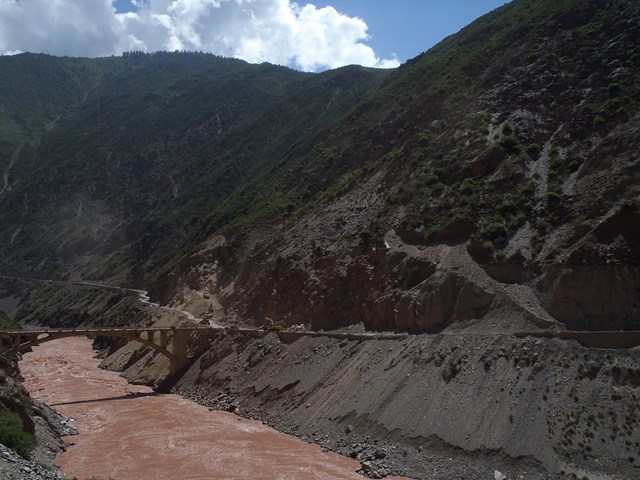
I came to this area first time 2009 and the road from Shangri-la to Deqin was under construction then. Half a year after it was finished the construction started again and is now almost done (besides the tunnel Through Baima Mountain which is supposedly going to be finished next year). Also the road through the village here is paved now and now they are doing the rest of it from the village to the bridge crossing the Mekong.

So some days ago i fried my computer cable but unfortunately the road construction had decided to blow up the road the next day so no bus was leaving the village. You could get to town by hiring a car to the construction site, hiking over it and getting another one from the other side. But that was a bit too much trouble so I decided to wait for a few days. Yesterday the bus was running again so I went to Deqin and luckily found a cable there saving me a trip to Shangri-la (again). Deiqin is a two street town with really nothing to do so I sat at the bus station reading my book. There’s a lot of construction happening in Deqin as well as the number of tourists is expected to explode especially next year which is the birth year of Kawa Gepo, the highest peak of Meili Mountains and holy to the Tibetans.

Deqin

Deqin

At one o’clock I got a call from my Tibetan brother that he was driving his friend’s car to the village and i could have a ride with him saving me from 2 hours of waiting (or so I thought). We got maybe half way to the bridge when the traffic was stopped first time because of constructions but it was only half an hour waiting. Then just before the bridge the traffic was stopped again. Road to Mingyong was open but you couldn’t go to Xidang before 5 which meant 2 hours of waiting.

Road to Xidang

Road to Xidang

Most cars turned back to Deqin at this point. My brother waited for an hour before he realized that the car he was driving wouldn’t make it over the construction site anyways. So he arranged me a drive in the only other car still waiting to get through. And this turned out to be the sunniest day of the week with no shade on this side of the river. And then half an hour before we could get through huge part of the slope fell down to the road!

Road construction

Ah, this meant more waiting and waiting while they cleared the road. And the slope wasn’t very stable so there were several smaller slides every time the wind picked up. Finally after 6 they started letting cars through from the other side. Some tourists decided to leave the car and ran through the slide. And then it was our turn. And here we go…

Here we go

And made it through without any problems! 🙂

Popping to the shop

A week ago my internet stopped working and I needed to go to the closest town Deqin to top up my card. There’s a public bus from Xidan to Deqin every morning at 8 and it comes back at 3 pm. But now dad has bought a truck and he had some business in town also so I could get a lift with him. “Great! So easy” I thought. No need to hike to the village early in the morning and then wait all day in Deqin for the bus to go back as there’s absolutely nothing to do in Deqin besides shopping for food. And besides the internet I could do some shopping. So off we went, slowly but surely until thee bridge crossing the Mekong River. Last year the road from Xidang hot springs was paved all the way down to Youngzhu village but the bit between the bridge and the villages is still under construction. And just before the bridge the traffic was stopped for maybe a half an hour.

Road to Xidang

Road to Xidang

But then we continued. Just before Deqin dad had to make a stop to fix something in the truck. I sat there waiting maybe for an hour until dad told me just to go ahead as the mechanics wanted to have lunch before fixing the truck. He’d call when all his business was done. So ok. I went to the road and one truck gave me a lift to Deqin. I had my lunch, fixed the internet problem and did some shopping and was done before 3 pm so I could have taken the bus back to Xidang but dad assured me that he’d be going home soon. So I sat on some steps and read my book waiting. And sat. And sat. Took a little walk every now and then when my legs started getting numb. Finally at 6.30 i called dad. He said he’s not finished so he’d be going home tomorrow. Which meant that i had to stay in a hotel for a night. I had 120 yuan left and the hotel room would be 80 + key deposit so I had to get more money. There used to be one ATM that gave money with foreign cards but that was now demolished. Instead there were 2 new banks. And I tried them all and none would give me money! So I had enough for the hotel and some instant noodles for dinner but then all was gone. And on top of it all I could have spend the whole day in a hotel room instead of sitting on some steps!

The next day mom called that dad had come home after all, although very late, but was back in Deqin now. But he wouldn’t be going home before late in the evening. I could take the public bus but that would use all the money I had and I’d have to wait 3 hours for it to leave. Sat on the steps again thinking when one mini-van driver came to ask if I was going to Shangri-la. Well, I might as well if it was ok with him that he drives me to a bank when we get there as I didn’t have any money at the moment. So off to Shangri-la, 4-hours drive just to get more money. And I’d have to stay at least one night as no cars would be driving back that day. … In the end it turned out to be 4 nights. The weather turned really bad, raining every day so I decided to stay in the guesthouse by the fire and interview some tourists and guides and see friends. As things here never seem to work as planned I was prepared enough so that I had my computer and toothbrush with me but not a change of clothes and such.

The mini-vans driving tourists up from Shangri-la bring their passengers straight to Feilaisi as no one wants to stay in Deqin unless they are catching early morning bus. So on the way back I got to Feilaisi around 1 pm and waited there for the bus back to the village. Bus to Foshan drove by, and one to Adong, but no Xidang bus. It was already almost 4 pm when a blue truck drove by. I didn’t pay much attention to it before I heard “Ou, Soniya!” behind me. It was dad! He had been buying cement from Deqin and was now on his way back home. So i got a ride back in dad’s truck after all. Sitting on top of the bags of cement! And the views were great from up there over the top of the truck cabin. Unfortunately this was the moment when my camera battery decided to die. So instead of great views, here is a selfie of me in dad’s truck when we were going up to Deqin.

Me

And next time, if I go to town with dad, I’ll be better prepared. And I want to ride at the back!

Ceremony, part 2

After lunch some of the women left but some relatives stayed to help to serve the guests who started to arrive. In the main room there were 80 butterlamps burning in memory of grandfather and the younger son of the family was in charge of keeping them burning throughout the day filling them with melted butter every time one went out. The lamas had also finished the altar and started chanting prayers sometimes beating the big drum and cymbals and ringing bells.

Butterlamps

Every guest brought gifts of eggs, noodles, alcohol, butter, barley grains, cheese and possibly meat or something else. Mom kept record of what each family gave so that they will pay back similarly when it’s their turn. Every guest got 2 bags of instant noodles. Previously this used to be youtiao (the pastries) but now everyone just uses instant noodles as the return gift.

Keeping record of gifts

Keeping record of gifts

All the guests were served home made noodles with pipa-meat so the big wok at the yard was kept boiling all day.

Noodles

Noodles

That was the first day. The second day the lamas continued their prayers in grandfathers room and the village elders came to pray in the main room. i could hear the chants of the lamas and the drums mixing with the chant of the elders.

Mantou (steamed bread) and fried vegetables with meat was served for lunch to the elders. I helped mom to serve the food and the elders thought it was very funny; a foreigner serving food to them! We had a good laugh!

Mantou

Mantou

Dad chopping vegetables

Dad chopping vegetables

The three oldest ladies of the village

The three oldest ladies of the village

After lunch the lamas and the elders had a break but continued the prayers from 3 till the evening when everyone left. This was the 2 day ceremony. Good bye grandfather. We were here to remember you and we hope you found your way!

Ceremony

On July 5th it was one year since grandfather died. According to their belief this is when the soul returns one more time to see the loved ones one more time before it departs permanently, so a ceremony is organized to help it find it’s way. The ceremony lasts 2 days. Preparations for it started already a few days before. Dad churned milk to make fresh butter, ground fresh tsampa (barley flower) and mom made fresh yak cheese.

Mom making cheese

Mom making cheese

Making cheese

Making cheese

On July 4th people started arriving after the morning duties were done (animals fed). Mostly women relatives arrived but also a few men to help prepare food for the guests. First mountains of flour needed to be sieved.

sieving

Also two lamas arrived. They were going to pray in grandfather’s room t help him find his way. They started by hanging a big drum on a frame that father had borrowed and baking tsampa cones for the altar. I’m no expert in Tibetan Buddhism so I don’t know what these are called or what is their purpose. I’ll ask and get back to it later if anyone is interested.

Prayer room

Prayer room

Tsampa cones

Tsampa cones

The women also started baking youtiao (kind of pastry with no filling cooked in oil). Some women baked at the terrace, others twisted the sweet pastries into shape in the main room and the cooking took place at the courtyard.

Baking

Cooking youtiao

Cooking youtiao

Mom’s brother prepared the pipa-meat (which is salted, dried pig meat, mostly skin and fat with a little bit of meat) that was to be served with noodles to the guests.

Burning off the hair from the pipa-meat. After this it's soaked to remove the salt, cooked and chopped.

Burning off the hair from the pipa-meat. After this it’s soaked to remove the salt, cooked and chopped.

After all the cooking was done it was time for lunch. This seemed to be women’s time together. We moved some tables to the terrace and ate warm youtiao with cold cucumber dish and, of course, lots of butter tea with yak cheese. After the women were done the men had their lunch.

Lunch

Lunch

To be continued….

Back in Xidang

As Xidang is located in the Meili Snow Mountains nature reserve you need to buy a ticket to get into the area. In principle the tickets are for Mingyong glacier and Yubeng village but everyone entering the area has to buy a ticket. Last year when i left they had just introduced a combined ticket. It included all the sights (Moon Light bend -viewing platform, Feilaisi viewing platform, Mingyong glacier and Yubeng village) and it cost 230 yuan. This rule, of course, applies only to tourists. Tibetan pilgrims can enter for free. The other passengers in the car from Shangri-la had all decided not to go to Yubeng as it would take too much time and was too expensive. As it turned out, the ticket pricing had changed just that day and now you could also buy separate tickets for each site. After short negotiations i was allowed to enter also without paying the ticket as I promised I wouldn’t be going to Yubeng and one of the girls at the gate had heard of me living in the village before.

Xidang village

Xidang village

When I arrived to the house grandma was at the yard spreading barley grains to dry. When she saw me she started crying. I was also very happy to see her as she’s already 85 years old so it is always uncertain if there will be a next time. And so it was with grandad. He had died July 5th the previous year. One year after the death the family organizes big ceremony as the soul returns to see the loved one more time before leaving permanently. And that day is today but more about that later…

Grandma

Grandma

And mom, who is always busy with the farm work, hurried home from the fields. Tibetans are not big on hugging but we were all smiles.

Temple by the Mekong

Temple by the Mekong

Shrinking distances

This time i flew into Kunming, China through Kuala Lumpur instead of the east coast cities. After a few days rest and getting used to the altitude (Kunming is about 1 800 m above sea level) I took the sleeper train to Lijiang (about 2000 m) where I again had a few days break from traveling. I wanted to meet friends and needed to prepare things for my work. From there i took a bus to Shangri-la. There has been huge road construction projects going on all over northern Yunnan during the past years and now they are finished. The new highway is elevated and there are bridges and tunnels through the mountains. Actually the new part goes only to the bridge crossing Yangtze River after which it is the old road. Surprisingly the new road doesn’t save much time, the 200 km stretch still takes about 4 hours. But the road is definitely safer now as it doesn’t wind along the mountain sides and go through villages; safer for both cars and the villagers. And the scenery can be seen better from the elevated road.

In Shangri-la I had a break again as it is about 3 300 m. My village, Xidang, is only around 2 000 m but i still needed to cross Baima Snow Mountains where the road at its highest goes at 4 200 m. Or this was the case before. Now there is a tunnel going through the mountains missing the most gorgeous bit of the journey.

Baima Snow Mountain

Baima Snow Mountain

As the public bus to Deqin obviously uses the tunnel there now is also an option for it besides hiring a car. Many of the previously privately owned and operated minivans now have a logo of one company. They gather customers from the different guesthouses in Shangri-la and drive them through the Baima pass all the way to Feilaisi which is where most tourists are going as you can see the whole Meili Snow Mountain range from there. The trip costs 80 yuan/per person. Even driving though the pass this trip took only 4 hours instead of the 6 it did before (180 km) and through the tunnel will be even faster.

Cars in Baima pass

Cars in Baima pass

Tractor in Baima pass

Tractor in Baima pass

The burning down of Shangri-la old town hasn’t affected the number of tourists going up to Meili, actually the opposite. Most tourists I met in the guesthouse in Shangri-la were either going to or coming from Meili.From Deqin I needed to hire a car to get to Xidang. There is one public buss going from the village to Deqin at 8 am and going back at 3 pm but the bus drives only to Xidang village and after that I’d need to hike up the mountain to our house. With all my luggage and the shopping I had to do (boxes of water and ice tea and such) I thought it better to hire one. The 37 km trip takes about an hour with a minivan and costs 250 yuan although I managed to bargain this down a bit. And then I was finally back in my Tibetan home after a year. So all said about the shrinking distances, it is still far! Of course the trip can be done faster by flying in to Shangri-la but you should be used to the altitude already to do that.

For trekking Baima, see http://nomadchina.blog.com/

Shangri-la after the fire

About 80% of Shangri-la old town (Dukezong in Tibetan) burned down in early January. The fire started at a guesthouse at the old town center and burned for nearly 10 hours. The fire trucks couldn’t get in to the narrow streets and water was either frozen or cut off which is usual in the old town winter time.

This photo is not from the fire this year. This was one building burning and the fire was luckily put down.

This photo is not from the fire this year. This was one building burning and the fire was luckily put down.

Luckily no one died in the fire although it started in the middle of the night. It was saddening visiting what was left of the town. The center burned down completely, some buildings were saved at the front and on the edges. The southern side and the temple on the hill are unharmed.

Spared by the fire. The front of the old town.

Spared by the fire. The front of the old town.

At the edge

At the edge

The old town square

The old town square

About the only building left standing - public toilet

About the only building left standing – public toilet

Beijing is pouring money into rebuilding the town and now they are also making proper water system. But the work is slow and everything is still mostly rubble with some blackened walls standing. The plan is to complete the work in three years.

Water system

Old town

The dance that took place every evening at the square has been moved to the southern part, the square in front of the temple.

Dancing Shangri-la

Dancing Shangri-la

Still dancing

Still dancing